
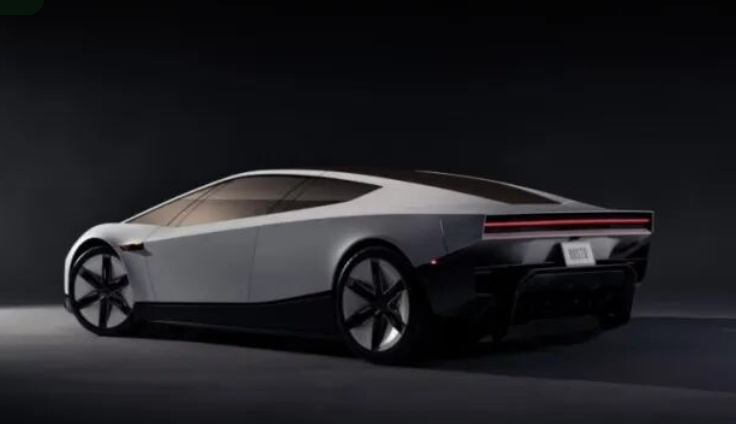
Fans, Thrusters, and Floating Promises: The Unproven Engineering Behind Tesla’s New Roadster
风扇、推进器与未兑现的承诺:特斯拉新一代 Roadster 的工程技术仍待验证
I. The Illusion of Flight
For decades, the flying car has occupied a special place in the public imagination. It represents more than a new mode of transportation. It promises a future in which the boundaries between science fiction and everyday life begin to disappear.
几十年来,飞行汽车在公众的想象中占据着特殊的地位。它不仅仅代表了一种新的交通方式,更预示着一个未来,届时科幻与日常生活的界限将开始消失。
occupy a place 占据一个地方、地位、位置
Technology occupies an important place in modern society.
这里的 place 不是某个具体的物理地点,而是抽象的“位置”,也就是科技在现代社会中所处的重要地位。
On October 15, 2026, Tesla brought that vision into the spotlight by unveiling its redesigned Roadster. At an event in Texas, the company demonstrated a series of extraordinary maneuvers: the vehicle drove upside down along a ramp, rotated in mid-air with the help of rocket-inspired thrusters, and briefly lifted off the ground to jump over other vehicles. Tesla also claimed that the car could accelerate from zero to 60 miles per hour in less than a second. Production is currently planned for 2028, according to Reuters.
2026年10月15日,特斯拉通过发布其重新设计的跑车,将这一愿景推向了聚光灯下。在德克萨斯州的一场活动中,该公司展示了一系列非凡的特技:汽车在斜坡上倒着行驶,在火箭推进器的帮助下在空中旋转,并短暂升空跃过其他车辆。特斯拉还声称,这款车能在不到一秒的时间内从静止状态加速到每小时60英里。据路透社报道,该车目前计划于2028年投产。
the spotlight [ U ]attention from newspapers, television and the public媒体和公众的注意
Unemployment is once again in the spotlight .
失业问题再次受到人们的关注。
The issue will come under the spotlight when parliament reassembles.
等议会重开的时候,这个问题将成为焦点。
The report has turned the spotlight on the startling rise in street crime.
这篇报道使人们将关注的目光投向街头犯罪激增的问题。
The demonstration was striking because it challenged a basic assumption about the automobile. For more than a century, cars have been designed primarily to move across the ground. Tesla’s latest vision suggests that the next frontier of automotive performance might involve leaving it altogether.
这次演示之所以引人注目,是因为它挑战了关于汽车的一个基本假设。一个多世纪以来,汽车的设计主要目的是在地面行驶。特斯拉的最新愿景表明,汽车性能的下一个前沿可能涉及完全摆脱地面。
Yet the spectacle also raises a more fundamental question: what exactly have we witnessed? A remarkable engineering achievement, an ambitious preview of future technology, or a carefully staged demonstration designed to capture the world’s attention?
然而,这一奇观也引发了一个更为根本性的问题:我们究竟见证了什么?是一项了不起的工程成就,是对未来技术的雄心勃勃的预览,还是一场精心策划的旨在吸引全世界注意力的演示?
These possibilities are not mutually exclusive. A product can represent genuine technical progress while also serving as a powerful marketing tool. The challenge is to distinguish what the demonstration has established from what the company is still promising.
这些可能性并非相互排斥。一个产品既能代表真正的技术进步,同时也能成为强大的营销工具。挑战在于区分演示所证明的内容与公司仍承诺的内容。
II. Defying Gravity: How Can a Car Drive Upside Down?
One of the most striking moments in the Roadster demonstration was its ability to travel upside down without falling. The idea seems to contradict our everyday experience of gravity, but the underlying principle is relatively straightforward.
Most high-performance cars use aerodynamic downforce to improve grip. As air flows around the vehicle, it creates forces that push the car toward the road. Tesla’s demonstrated system takes a different approach: fans draw air out from beneath the chassis, creating a lower-pressure region that helps hold the vehicle against the track.
Think of it as the difference between pushing something against a surface and using suction to keep it attached. When the car is inverted, the pressure difference can help prevent it from falling away from the track.
The basic physics is not especially mysterious. The more interesting question is whether the system can produce enough suction, consistently and efficiently, while the vehicle is moving.
Consider a simplified example. Imagine a car weighing 2,000 kilograms, with an effective suction area of five square meters. To generate a suction force equivalent to twice the car’s weight, the system would need an average pressure difference of roughly 7.8 kilopascals across that area. This is an illustrative estimate based on assumed dimensions, not a measurement of the Roadster itself.
The calculation gives us a sense of the scale involved, but it does not establish whether the system is practical. The main difficulty is maintaining that pressure difference as conditions change. Air can leak into the space beneath the chassis, particularly when the gap between the car and the track varies. Greater leakage means the fans must move more air to maintain the same suction, potentially increasing energy consumption.
This creates a difficult trade-off. The system must generate sufficient suction without adding excessive weight, consuming too much power, or becoming unreliable when the surface is less than ideal.
Tesla has reportedly described the system as capable of producing suction equivalent to as much as twice the vehicle’s weight. That figure should be treated as a manufacturer claim rather than an independently verified measurement. The demonstration shows that the concept can work under the conditions presented; it does not tell us how well it would perform on uneven surfaces or under changing operating conditions.
The distinction matters because an impressive stunt and a practical automotive technology are judged by different standards. The former needs to work once, under carefully managed circumstances. The latter must work repeatedly, predictably, and without imposing unreasonable costs or risks on its users.
III. Rocket-Inspired Thrusters: A Brief Jump into the Future
If suction explains how the Roadster can remain attached to an inverted track, rocket-inspired thrusters offer a possible explanation for its airborne maneuvers.
The principle is familiar from rocketry. A thruster releases pressurized gas, producing a force in the opposite direction. By coordinating several thrusters, a vehicle can generate not only upward movement but also the rotational forces needed to change its orientation.
This is a meaningful departure from conventional automotive engineering. Cars are normally designed to maintain contact with the road, relying on their tires to accelerate, brake, and turn. Once a vehicle leaves the ground, however briefly, its tires can no longer provide those familiar forms of control. The propulsion and control systems must do much more of the work.
But there is a crucial difference between making a car jump and keeping it airborne.
A short burst of thrust may be enough to lift a vehicle for a brief maneuver. Sustained flight requires a continuing supply of thrust and energy, together with the ability to control the vehicle throughout its time in the air. The system must also carry enough gas to perform the maneuver, while accounting for the additional weight of the pressure vessels and associated hardware.
These requirements create competing demands. More stored gas may support longer or more powerful maneuvers, but it also adds weight. Greater thrust may improve the vehicle’s ability to rise or rotate, but the system still needs sufficient control to bring it back down safely.
Without detailed, independently verified specifications for the Roadster’s thrusters, gas supply, and control system, it is not possible to estimate its actual airborne duration reliably. Nor does a successful jump establish that the vehicle could function as a practical flying car.
That does not make the demonstration meaningless. On the contrary, it illustrates how technologies developed for one purpose can inspire new possibilities in another field. But the Roadster’s airborne capabilities should be understood in their demonstrated context: short, controlled maneuvers rather than evidence of sustained flight.
The distinction is more than a technicality. It separates a vehicle that can perform an extraordinary trick from one that can safely navigate an entirely new mode of transportation.
IV. From Prototype to Public Roads: The Hard Part Begins
A controlled demonstration takes place under conditions that engineers can prepare for. Public roads are far less forgiving.
On a test track, the surface can be inspected, the maneuver rehearsed, and access restricted. Ordinary driving introduces uneven pavement, unexpected obstacles, changing weather, and the unpredictable actions of other road users. A system that performs well in a controlled environment must still prove that it can cope with these variables.
For the Roadster, the challenges extend beyond its ability to accelerate or leave the ground. The suction system must respond to changes in surface geometry. The thrusters and their control systems must operate predictably across repeated uses. The vehicle’s structure and other components must withstand the forces associated with unusual maneuvers, while the overall design must account for failures that could occur at the worst possible moment.
The consequences of failure also deserve attention. A malfunction during an ordinary drive may already be dangerous; a malfunction during an airborne maneuver could introduce additional risks. Engineers would need to establish how the vehicle responds to faults, whether it can return to a safe state, and what safeguards protect occupants and bystanders.
Regulation presents another hurdle. A vehicle that remains on the road falls primarily within the applicable motor-vehicle safety framework. A vehicle designed to leave the ground may raise additional questions about where such maneuvers can take place and which aviation or other rules might apply. The exact requirements depend on the vehicle’s design, intended use, and jurisdiction. It would therefore be premature to assume that the proposed features are either automatically legal on public roads or universally prohibited.
Then there is the less glamorous challenge of ownership. Sophisticated propulsion hardware must be manufactured consistently, inspected, maintained, and repaired. Customers need to know not only what a vehicle can do when new, but also how reliably it will perform after years of use.
These are not minor details to be addressed after the exciting work is finished. They are part of what makes a technology a viable product in the first place.
Tesla’s planned 2028 production date provides a target, but a target is not the same as a demonstrated production capability. The real test will be whether the company can translate its prototype’s performance into a vehicle that meets clearly defined safety, reliability, and regulatory requirements.
V. A New Performance Paradigm or a Marketing Masterstroke?
The Roadster is an unusual product even by Tesla’s standards. Its appeal lies not only in its promised speed, but also in its ability to capture the imagination. In a market where electric vehicles increasingly compete on familiar measures such as range, charging convenience, and price, a car that can drive upside down and perform airborne maneuvers offers something far more distinctive: a story that people want to talk about.
That distinction has commercial value.
Automakers have long used flagship vehicles to showcase their most ambitious engineering and reinforce their brand identities. Such cars are often expensive, exclusive, and produced in relatively small numbers. Their importance may lie less in direct sales than in the attention they generate and the image they create for the wider company. In the automotive industry, this role is often described as that of a halo car.
The Roadster fits that model. Its unusual features give Tesla a way to present itself as a company capable of pushing beyond the familiar boundaries of electric-car design. The collaboration with SpaceX adds another layer to that story, connecting automotive performance with the cultural appeal of rocket technology.
The timing is also worth considering. The next-generation Roadster was first revealed in 2017, with deliveries originally expected in 2020. After years of delays, the latest demonstration gives Tesla a dramatic new chapter in a story that might otherwise have become defined by waiting. It also arrives as the company increasingly emphasizes autonomous driving and robotics alongside its traditional vehicle business, according to Reuters.
This does not prove that the Roadster is merely a publicity exercise. Genuine engineering ambition and marketing strategy can reinforce each other. A dramatic demonstration can attract attention precisely because it showcases technology that engineers have worked to develop. At the same time, the resulting attention can strengthen a brand, generate renewed interest in a long-delayed product, and keep the company at the center of public conversation.
The more important question is whether that attention can translate into lasting value.
A spectacular launch can create excitement, but customers ultimately need a product they can buy and use. Investors, meanwhile, must distinguish the publicity surrounding a flagship vehicle from its likely financial contribution. Reuters reported that Elon Musk had previously played down the Roadster’s potential impact on Tesla’s finances, describing it as a “small potato situation.” The company has also yet to establish, through production and delivery, that the latest promises can be fulfilled at scale.
The Roadster’s commercial success will therefore depend on more than its ability to attract headlines. Its price, reliability, production schedule, and practical benefits will shape whether customers see it as a worthwhile purchase or an expensive demonstration of technological ambition.
There is also a broader lesson here about innovation. Extraordinary products can expand our sense of what is possible, even when their most radical features never become mainstream. But spectacle alone cannot establish a new performance paradigm. For that, the technology must offer benefits that are repeatable, meaningful, and worth the cost.
The Roadster may ultimately become a landmark in automotive engineering, a highly distinctive halo car, or some combination of the two. The available evidence does not yet settle that question. What it does show is how closely technological ambition and brand storytelling can become intertwined.
Conclusion: Beyond the Spectacle
The appeal of the new Roadster is easy to understand. It takes the familiar idea of an electric sports car and pushes it into territory that once belonged largely to science fiction. Suction systems and rocket-inspired thrusters offer a glimpse of what can happen when engineers are willing to challenge conventional assumptions.
Yet the most consequential achievements in engineering rarely end with a spectacular demonstration. They begin there, then continue through testing, refinement, manufacturing, and the less visible work of making an ambitious idea dependable.
Tesla has shown a vision of what the Roadster might become. Whether that vision leads to a practical new category of vehicle—or remains an extraordinary showcase of engineering and marketing—will depend on what follows.
Making a car appear to defy gravity can capture the world’s attention. Turning that moment into a safe, reliable, and commercially viable product would be the real achievement.